Fundamentals 7 min read
SCADA vs HMI vs PLC vs DCS: what is the difference?
A PLC controls in the field, an HMI shows the process to the operator, SCADA watches scattered sites from a control center and a DCS runs one plant's process as a single system.
Published:
A PLC is an industrial computer that controls a machine or a process in the field. An HMI is the screen where an operator watches and operates that process. SCADA is the system that collects data from PLCs, RTUs and other field devices spread over a wide area and gives a control center monitoring, alarms, history and remote control. A DCS controls a large process inside one plant as a single system of controllers, operator screens and engineering tools.
The four terms get mixed up because a plant usually has all of them at once. They differ in the job each one does and where it sits.
What is a PLC?
A programmable logic controller (PLC) reads its inputs, runs its control program and updates its outputs, and it repeats that scan many times a second. Starting a pump at a tank level, setting a conveyor’s speed and interlocking a valve are all jobs for a PLC.
The first PLCs appeared in the late 1960s to replace the relay panels of car factories. Today most PLC programs are written in the languages of IEC 61131-3: ladder diagram (LD), function block diagram (FBD), structured text (ST) and sequential function chart (SFC).
A PLC needs no screen to do its work. If its link to the HMI or to SCADA drops, it keeps running its program.
RTUs and IEDs
A remote terminal unit (RTU) is similar to a PLC but built for remote, scattered sites: substations, pumping stations, valve chambers along a pipeline. It records events with time stamps and reports them to the control center over telemetry protocols such as IEC 60870-5-104 or DNP3, which we compare in a separate article. An intelligent electronic device (IED) is the general name for field devices with their own processor, such as protection relays and power meters.
What is an HMI?
A human-machine interface (HMI) is the screen where an operator sees and controls the process. A touch panel next to a machine is an HMI, and so is an operator station in a control room. It shows values and states, announces alarms and passes the operator’s commands (start, stop, setpoint) to the controller.
A panel HMI usually belongs to one machine or line and talks to one PLC. Control room screens are most often part of a SCADA system. Our article on simple SCADA screen design covers how to lay them out.
What is SCADA?
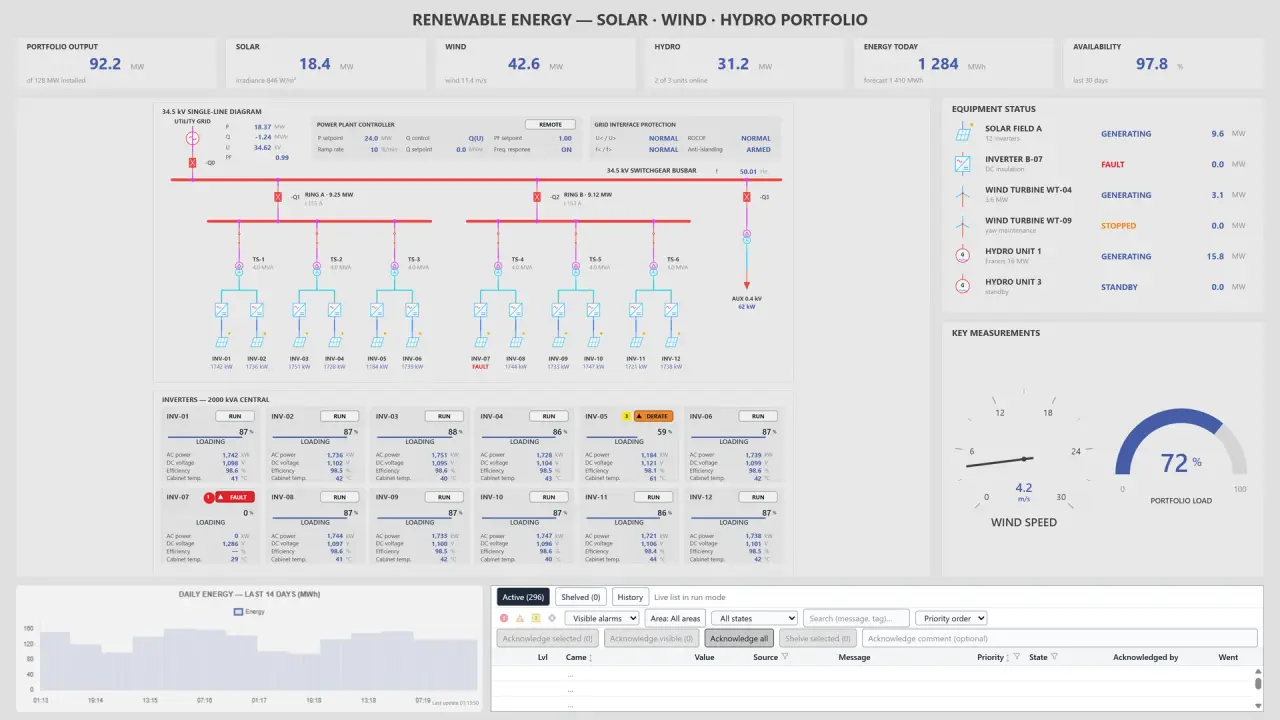
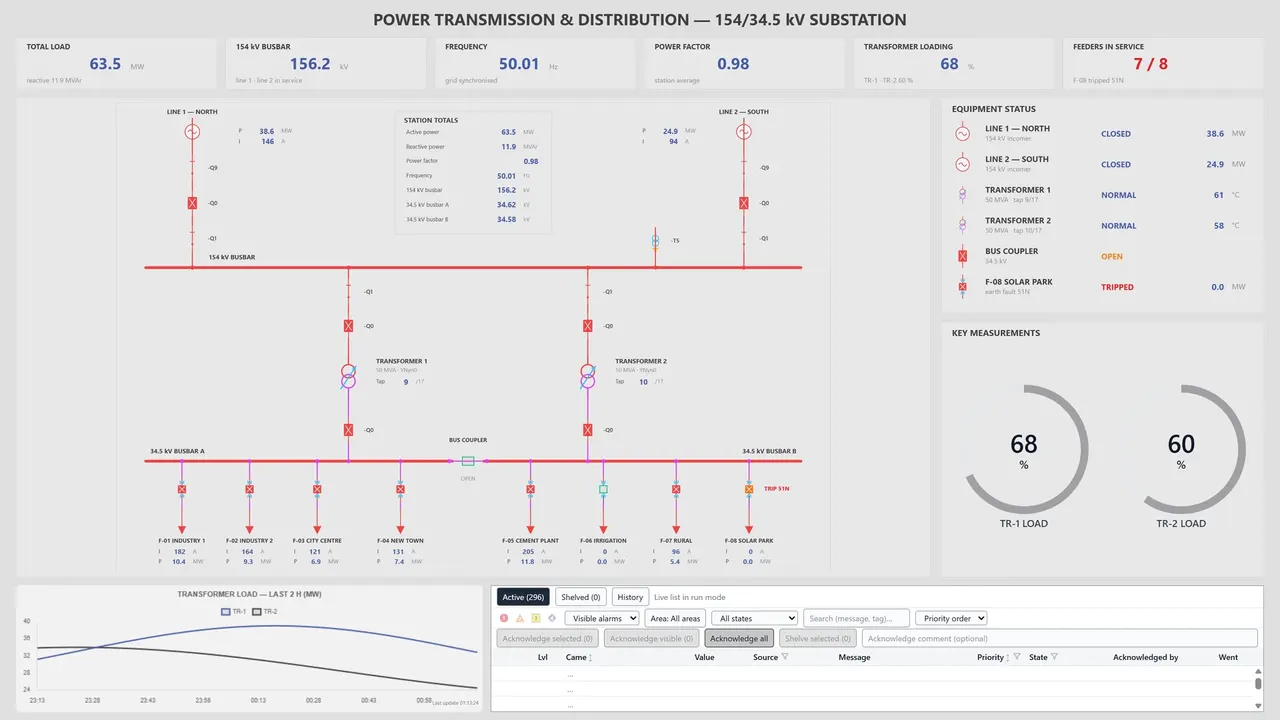
Supervisory control and data acquisition (SCADA) collects data from many PLCs, RTUs and field devices. It presents that data in a control center as screens, alarms and history, and it sends operators’ commands back to the field. NIST’s guide to operational technology security (SP 800-82) describes SCADA systems as those used to control dispersed assets, where centralized data acquisition matters as much as control. Power transmission and distribution grids, water and wastewater networks and oil and gas pipelines are typical examples.
A SCADA system usually has these parts:
- Communication drivers talk to field devices in their own protocols.
- Runtime screens are the HMI layer where operators watch and operate the plant.
- Alarm management evaluates limits, announces alarms and records acknowledgments and history.
- A historian stores measurements and events over time for trends and later analysis.
- User and permission management decides who sees what and who may send commands.
The control in SCADA is supervisory. The time-critical control loop runs in the PLC or RTU in the field. SCADA sends setpoints and commands to those devices and watches the result.
What is a DCS?
A distributed control system (DCS) runs large continuous or batch processes inside one plant: refineries, chemical and petrochemical plants, power stations. Control is spread across many networked controllers, each running part of the process.
A DCS is built as one integrated system. Its controllers, operator screens, historian and engineering tools usually come from one vendor and share one database. A control loop (PID) defined at the engineering station reaches both the controller and the operator screen from that single definition. Honeywell (TDC 2000) and Yokogawa (CENTUM) released the first DCS products in 1975.
SCADA vs DCS
The two do much the same things: both collect data, display it, raise alarms and send commands. The practical differences are these:
- Scope: SCADA watches sites spread over many kilometers. A DCS stays inside one plant.
- Communication: SCADA often runs over links that have limited bandwidth and can drop, so it uses protocols that report changes and carry time-stamped events. A DCS keeps its controllers and screens on a fast plant network.
- Where control runs: In a DCS, closed-loop control runs in the system’s own controllers. With SCADA it stays in the PLCs and RTUs in the field, and SCADA supervises them.
- Devices: A DCS is mostly one vendor’s ecosystem. SCADA talks to devices from many vendors over standard protocols.
In practice the line is not sharp. SCADA systems now run inside single factories, and a DCS can connect to RTUs at remote sites.
Side by side
| PLC | HMI | SCADA | DCS | |
|---|---|---|---|---|
| Job | Controls a machine or process | Shows the process, takes operator commands | Collects data from scattered sites, monitors and controls | Controls a plant’s process as one system |
| Where it runs | In the field, in a cabinet | Next to the machine or in a control room | In the control center, on a server | Controllers in the field, screens in the control room |
| Scope | One machine or line | A machine, a line or a plant | A region, a network or many plants | One plant |
| Typical use | Pumps, conveyors, packaging machines | Operator panels | Power, water, pipelines | Refineries, power plants, chemical plants |
How they work together
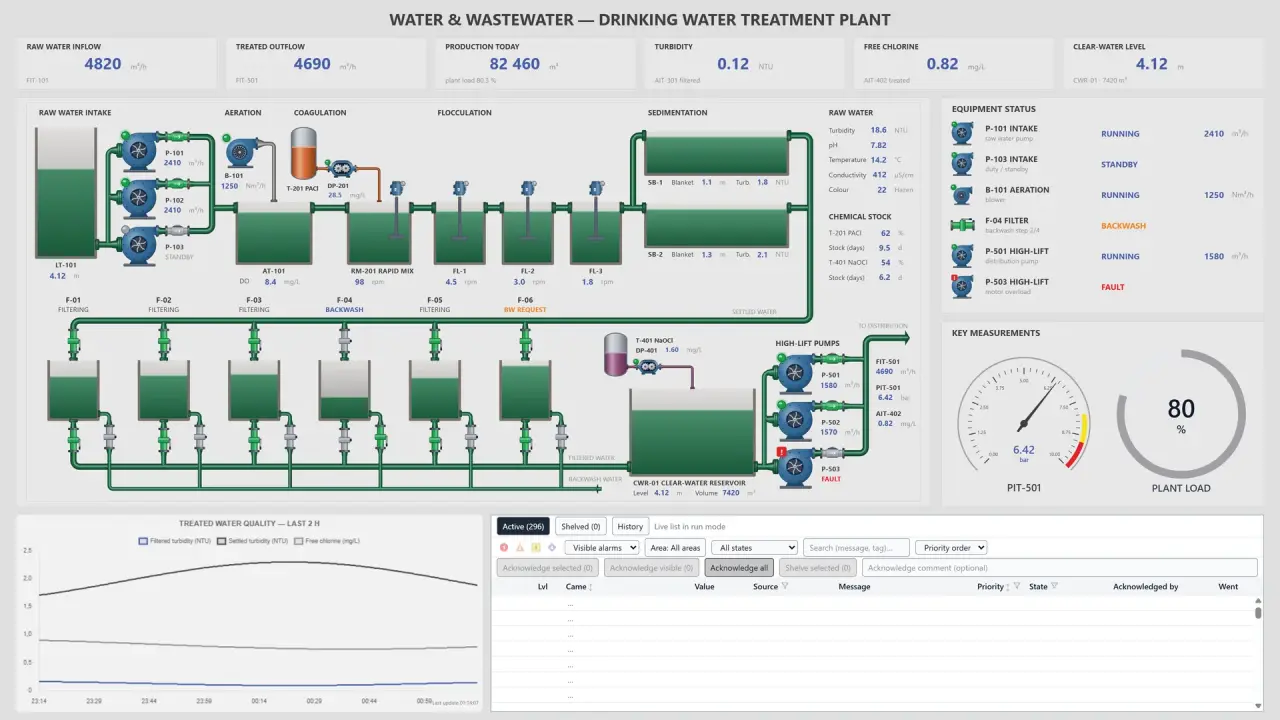
Take a water distribution network. PLCs at the pumping stations start and stop pumps by tank level. Each station has a small operator panel (HMI) for the maintenance crew. The SCADA system in the control center collects data from the station PLCs and from RTUs in the valve chambers. The operator sees the whole network on one screen, acknowledges alarms and can stop a pump remotely. If the treatment plant itself runs on a DCS, the SCADA system can take summary data from it too.
The layered model that NIST SP 800-82 also uses, the Purdue model, sums this up. Sensors, actuators and motor drives sit at the bottom. Control devices such as PLCs and RTUs sit above them, supervisory systems such as SCADA and HMIs above those, and plant management and enterprise systems on top.
Frequently asked questions
Are SCADA and HMI the same thing?
No. An HMI is the screen an operator looks at. SCADA also covers communication with many devices, alarm management and the historian. Every SCADA system has HMI screens, but not every HMI is a SCADA system.
Can you use SCADA without a PLC?
SCADA needs a field device to collect data from. That can be a PLC, but also an RTU, a protection relay, a power meter or an OPC UA server.
SCADA or DCS?
A DCS fits a large continuous process in one plant when you want an integrated system from one vendor. SCADA fits scattered sites, devices from different vendors and communication over standard protocols. In practice, the devices already in the field and the operator’s specification often decide.
In YTCC
YTCC is a SCADA/HMI platform. It collects data from PLCs, RTUs and field devices and lets you design and operate screens, alarms, historian and server scripts from a web browser. The control programs keep running in the field devices. YTCC talks to PLCs over Modbus TCP, Siemens S7, EtherNet/IP, Beckhoff ADS and OPC UA, and to RTUs over IEC 60870-5-104, IEC 60870-5-101 and DNP3. The full list is on the Platform page.
You design screens in the browser with the Web Editor. To try YTCC yourself, download it.